Monday, February 17, 2020


                 The Tomb of Isaac, 1911


Isaac in Islam
The biblical patriarch Isaac (Arabic: إسحاق‎ or إسحٰق[note A] Isḥāq) is recognized as a patriarch, prophet and messenger of God by Muslims.[1] In Islam, he is known as Isḥāq. As in Judaism and Christianity, Islam maintains that Isaac was the son of the patriarch and prophet Abraham from his wife Sarah. Muslims hold Isaac in deep veneration because they believe that both Isaac and his older half-brother Ishmael continued their father's spiritual legacy through their subsequent preaching of the message of God after the death of Abraham.[2] Isaac is mentioned in fifteen passages of the Qur'an.[3] Along with being mentioned several times in the Qur'an Isaac is held up as one of Islam's prophets.
Early life
Because of God’s grace and covenant with Abraham Sarah was gifted with a child in her old age. Isaac was the age of 10 when his half-brother Ishmael went out from Abraham’s house into the desert. While in the desert Ishmael took a wife of the daughters of Moab named ‘Ayeshah. Abraham went out into the desert after three years to find his son Ishmael out of love for him and this is what started the separation between Jewish and Arab traditions.[4]
In the Qur'an
Isaac is mentioned fifteen times by name in the Qur'an, often with his father and his son, Yaʿqūb (Jacob).[5] The Qur'an states that Abraham received "good tidings of Isaac, a prophet, of the righteous", and that God blessed them both (37: 112). "And We gave him glad tidings of Isaac, a prophet from among the righteous. And We blessed him and Isaac. And among their progeny are the virtuous and those who clearly wrong themselves"[6] In a fuller description, when angels came to Ibrahim to tell him of the future punishment to be imposed on Sodom and Gomorrah, his wife, Sarah, "laughed, and We gave her good tidings of Isaac, and after Isaac of (a grandson) Jacob" (11: 71-74); and it is further explained that this event will take place despite Abraham and Sarah's old age. Several verses speak of Isaac as a "gift" to Abraham (6: 84; 19: 49-50), and 29: 26-27 adds that God made "prophethood and the Book to be among his offspring", which has been interpreted to refer to Abraham's two prophetic sons, his prophetic grandson Jacob, and his prophetic great-grandson Joseph. In the Qur'an, it later narrates that Abraham also praised God for giving him Ishmael and Isaac in his old age (XIV: 39-41).
Elsewhere in the Qur'an, Isaac is mentioned in lists: Joseph follows the religion of his forefathers Abraham, Isaac and Jacob (12: 38) and speaks of God's favor to them (12: 6); Yaʿqūb's sons all testify their faith and promise to worship the God that their forefathers, "Abraham, Ishmael and Isaac", worshiped (2: 127); and the Qur'an commands Muslims to believe in the revelations that were given to "Abraham, Ishmael, Isaac, Jacob and the Patriarchs" (2: 136; III: 84). In the Qur'an's narrative of Abraham's near-sacrifice of his son (37: 102), the name of the son is not mentioned and debate has continued over the son's identity, though many feel that the identity is the least important element in a story which is given to show the courage that one develops through faith.[7]
Burial site

The Tomb of Isaac, 1911

His tomb and that of his wife Rebekah is considered to be in the Cave of the Patriarchs in Hebron, known in Islam as the Ibrahim-i-Mosque ("Mosque of Abraham"). Alongside Isaac's cenotaph are the cenotaphs of some of the other Qur'anic/Biblical patriarchs and their wives: Abraham and Sarah and Jacob and Leah.
See also[edit]
Biblical narratives and the Quran
Prophets of Islam
Stories of The Prophets#fastitlinks.com

                 Hud (prophet)


Historical context

See also: Arabian Desert and Rub' al Khali
Hud has sometimes been identified with Eber,[9] an ancestor of the Israelites who is mentioned in the Old Testament.
He is said to have been a subject of a mulk (Arabic: مُـلـك‎, kingdom) named after its founder, ‘Ad, a fourth-generation descendant of Noah (his father being Uz, the son of Aram, who was the son of Shem, who, in turn, was a son of Noah):

The ʿĀd people, with their prophet Hud, are mentioned in many places. See especially Quran 26:123–140 (Yusuf Ali), and Quran 46:21–26 (Yusuf Ali). Their story belongs to Arabian tradition. Their eponymous ancestor ‘Ad was fourth in generation from Noah, having been a son of 'Aus, the son of Aram, the son of Sam, the son of Noah. They occupied a large tract of country in Southern Arabia, extending from Umman at the mouth of the Persian Gulf to Hadhramaut and Yemen at the southern end of the Red Sea. The people were tall in stature and were great builders. Probably the long, winding tracts of sands (ahqaf) in their dominions (46:21) were irrigated with canals. They forsook the true God, and oppressed their people. A three years famine visited them, but yet they took no warning. At length a terrible blast of wind destroyed them and their land, but a remnant, known as the second ʿĀd or the Thamud (see below) were saved, and afterwards suffered a similar fate for their sins. The tomb of the Prophet Hud (qabr Nabi Hud) is still traditionally shown in Hadhramaut, latitude 16 N, and longitude 49​1⁄2 E, about 90 miles north of Mukalla. There are ruins and inscriptions in the neighborhood.
— Abdullah Yusuf Ali, The Holy Qur'an: Text, Translation and Commentary, Note 1040[10]
The other tribes claimed to be present at this time in Arabia, were the Thamud, Jurhum, Tasam, Jadis, Amim, Midian, Amalek Imlaq, Jasim, Qahtan, Banu Yaqtan and others.[11]
The Quran gives the location of ʿĀd as being Al-Aḥqāf (Arabic: الأَحـقَـاف‎, "The Sandy Plains," or "the Wind-curved Sand-hills").[6][12][13] It is believed to have been in the southern part of the Arabian Peninsula, possibly in eastern Yemen and/or western Oman. In November 1991, a settlement was discovered and hypothesized for Ubar,[14] which is thought to be mentioned in the Qur'an as Iram dhāṫ al-‘Imād (Arabic: إِرَم ذَات الـعِـمَـاد‎, Iram of the Pillars; an alternative translation is Iram of the tentpoles),[8][13] and may have been the capital of ʿĀd. One of the members of the original expedition, archeologist Juris Zarins, however, later concluded that the discovery did not represent a city called Ubar.[15][16] In a 1996 interview on the subject he said:
If you look at the classical texts and the Arab historical sources, Ubar refers to a region and a group of people, not to a specific town. People always overlook that. It's very clear on Ptolemy's second century map of the area. It says in big letters "Iobaritae". And in his text that accompanied the maps, he's very clear about that. It was only the late medieval version of One Thousand and One Nights, in the fourteenth or fifteenth century, that romanticised Ubar and turned it into a city, rather than a region or a people."[17]
Narrative in the Quran
This is a brief summary of Hud's narrative, with emphasis on two particular verses:
The people of ʿĀd were extremely powerful and wealthy and they built countless buildings[18] and monuments to show their power. However, the ʿĀd people's wealth ultimately proved to be their failure, as they became arrogant and forsook God and began to adopt idols for worship, including three idols named Samd, Samud and Hara.[11] Hud, even in childhood, remained consistent in prayer to God. It is related through exegesis that Hud's mother, a pious woman who had seen great visions at her son's birth, was the only person who encouraged Hud in his worship. Thus, the Lord raised up Hud as a prophet for the ʿĀd people.
When Hud started preaching and invited them to the worship of only the true God and when he told them to repent for their past sins and ask for mercy and forgiveness, the ʿĀd people began to revile him and wickedly began to mock God's message. Hud's story epitomizes the prophetic cycle common to the early prophets mentioned in the Quran: the prophet is sent to his people to tell them to worship God only and tells them to acknowledge that it is God who is the provider of their blessings[9] The Quran[3] states:
We sent to the people of 'Ad their brother Hud, who said: "O my people, worship God; you have no other god but He. (As for the idols,) you are only inventing lies.
O my people, I ask no recompense of you for it: My reward is with Him who created me. Will you not, therefore, understand?
O my people, beg your Lord to forgive you, and turn to Him in repentance. He will send down rain in torrents for you from the skies, and give you added strength. So do not turn away from Him as sinners."
They said: "O Hud, you have come to us with no proofs. We shall not abandon our gods because you say so, nor believe in you.
All we can say is that some of our gods have smitten you with evil." He replied:" I call God to witness, and you be witness too, that I am clear of what you associate (in your affairs)
Apart from Him. Contrive against me as much as you like, and give me no respite.
I place my trust in God who is my Lord and your Lord. There is no creature that moves on the earth who is not held by the forelock firmly by Him. Verily the way of my Lord is straight.
If you turn away, then (remember) I have delivered to you the message I was sent with. My Lord will put other people in your place, and you will not be able to prevail against Him. Indeed my Lord keeps a watch over all things."
— Qur'an, sura 11 (Hud), ayah 50-57
Hud preached to the people of ʿĀd for a long time. The majority of them, however, refused to pay any notice to his teachings and they kept ignoring and mocking all he said. As their aggression, arrogance and idolatry deepened, God, after plenty of warning, sent a thunderous storm to finish the wicked people of ʿĀd once and for all. The destruction of the ʿĀd is described in the Quran:[6]
So when they saw it as a cloud advancing towards their valleys, they said: "This is just a passing cloud that will bring us rain." "No. It is what you were trying to hasten: The wind which carries the grievous punishment!
It will destroy everything at the bidding of its Lord." So in the morning there was nothing but their empty dwellings to be seen. That is how We requite the sinners.
— Qur'an, Surah 46 (Al-Ahqaf), ayah 24-25
In other religions
Judaism and Christianity do not venerate Hud as a prophet and, as a figure, he is absent from the Bible. However, there are several pre-Quranic references to individuals named Hud or possessing a name which is connected to Hud as well as references to the people of ʿĀd.[9] The name Hud also appears in various ancient inscriptions, most commonly in the Hadhramaut region.
Place of burial
Several sites are revered as the tomb of Hud. The most noted site, Kabr Nabi Hud, is located in the deserted village of the Hadhramaut region, around 90 mi (140 km) north of Mukalla, and is a place of frequent Muslim pilgrimage. Robert Bertram Serjeant in his study of the pilgrimage rite to the tomb of Hud verified on the spot[19] the facts related by al-Harawi,[20]:97/220-1 who described, at the gate of the Mosque, on the west side, the rock onto which Hud climbed to make the call to prayer and mentioned the grotto of Balhut at the bottom of the ravine.[1] Around the tomb and neighborhood, various ancient ruins and inscriptions have been found.[21] However, as is often the case with the graves of prophets, other locations have been listed. A possible location for his qabr (Arabic: قـبـر‎, grave) is said to be near the Zamzam Well,[20]:86/98 or in the south wall of the Masjid in Damascus.[20]:15/38 Some scholars have added that the Masjid has an inscription stating: "Hadha Maqam Hud" (Arabic: هـذا مـقـام هـود‎, "This is (the) Tomb of Hud");[22] others, however, suggest that this belief is a local tradition spewing from the reverence the locals have for Hud.[1]#fasritlinks.com


Elijah appeared at the Transfiguration of Jesus.


Elijah (/ɪˈlaɪdʒə/ ih-LY-jə; Hebrew: אֵלִיָּהוּ, Eliyahu, meaning "My God is Yahweh[1]/YHWH"[2][3]) or latinized form Elias (/ɪˈlaɪəs/ ih-LY-əs)[a] was, according to the Books of Kings in the Hebrew Bible, a prophet and a miracle worker who lived in the northern kingdom of Israel[4] during the reign of King Ahab (9th century BC). In 1 Kings 18, Elijah defended the worship of the Hebrew God over that of the Canaanite deity Baal. God also performed many miracles through Elijah, including resurrection (raising the dead), bringing fire down from the sky, and entering Heaven alive "by fire".[5] He is also portrayed as leading a school of prophets known as "the sons of the prophets".[6] Following his ascension, Elisha, his disciple and most devoted assistant took over his role as leader of this school. The Book of Malachi prophesies Elijah's return "before the coming of the great and terrible day of the LORD",[7] making him a harbinger of the Messiah and of the eschaton in various faiths that revere the Hebrew Bible. References to Elijah appear in Ecclesiasticus, the New Testament, the Mishnah and Talmud, the Quran, the Book of Mormon, the Doctrine and Covenants, and Bahá'í writings.

In Judaism, Elijah's name is invoked at the weekly Havdalah rite that marks the end of Shabbat, and Elijah is invoked in other Jewish customs, among them the Passover Seder and the brit milah (ritual circumcision). He appears in numerous stories and references in the Haggadah and rabbinic literature, including the Babylonian Talmud.

The Christian New Testament notes that some people thought that Jesus was, in some sense, Elijah,[8] but it also makes clear that John the Baptist is "the Elijah" who was promised to come in Malachi 3:1;4:5.[9] Christian doctrine says that Elijah appeared with Moses during the Transfiguration of Jesus.

In Islam, Elijah appears in the Quran as a prophet and messenger of God, where his biblical narrative of preaching against the worshipers of Baal is recounted in a concise form.[10] Due to his importance to Muslims, Catholics, and Orthodox Christians, Elijah has been venerated as the patron saint of Bosnia and Herzegovina since 1752.[11]
Biblical accounts

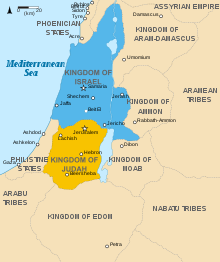
Map of Israel as it was in the 9th century BC. Blue is the Kingdom of Israel. Golden yellow is the Kingdom of Judah.

According to the Bible, by the 9th century BC, the Kingdom of Israel, once united under Solomon, divided into the northern Kingdom of Israel and the southern Kingdom of Judah (which retained the historical capital of Jerusalem along with its Temple). However, scholars today do not always agree as to whether the united Kingdom under Solomon ever existed.[12] Omri, King of Israel, continued policies dating from the reign of Jeroboam, contrary to religious law, that were intended to reorient religious focus away from Jerusalem: encouraging the building of local temple altars for sacrifices, appointing priests from outside the family of the Levites, and allowing or encouraging temples dedicated to Baal, an important deity in ancient Canaanite religion.[13][14] Omri achieved domestic security with a marriage alliance between his son Ahab and princess Jezebel, a priestess of Baal and the daughter of the king of Sidon in Phoenicia.[15] These solutions brought security and economic prosperity to Israel for a time,[16] but did not bring peace with the Israelite prophets, who advocated a strict deuteronomic interpretation of the religious law.

Under Ahab's kingship tensions exacerbated. Ahab built a temple for Baal, and his wife Jezebel brought a large entourage of priests and prophets of Baal and Asherah into the country. In this context Elijah is introduced in 1 Kings 17:1 as Elijah "the Tishbite". He warns Ahab that there will be years of catastrophic drought so severe that not even dew will form, because Ahab and his queen stand at the end of a line of kings of Israel who are said to have "done evil in the sight of the Lord".
1st and 2nd Kings

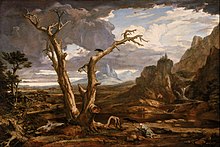
Elijah in the wilderness, by Washington Allston

No background for the person of Elijah is given except for his brief characterization as a "Tishbite". His name in Hebrew means "My God is Yahweh", and may be a title applied to him because of his challenge to worship of Baal.[17][18][19][20][21]

As told in the Hebrew Bible, Elijah's challenge is bold and direct. Baal was the Canaanite god responsible for rain, thunder, lightning, and dew. Elijah thus, when he initially announces the drought, not only challenges Baal on behalf of God himself, but he also challenges Jezebel, her priests, Ahab and the people of Israel.[22]
Widow of Zarephath[edit]
Main article: Raising of the son of the widow of Zarephath

Elijah reviving the Son of the Widow of Zarephath by Louis Hersent

After Elijah's confrontation with Ahab, God tells him to flee out of Israel, to a hiding place by the brook Chorath, east of the Jordan, where he will be fed by ravens.[23] When the brook dries up, God sends him to a widow living in the town of Zarephath in Phoenicia. When Elijah finds her and asks to be fed, she says that she does not have sufficient food to keep her and her own son alive. Elijah tells her that God will not allow her supply of flour or oil to run out, saying, "Do not be afraid...For thus says the Lord the God of Israel: The jar of meal will not be emptied and the jug of oil will not fail until the day that the Lord sends rain on the earth."[24] She feeds him the last of their food, and Elijah's promise miraculously comes true. God gave her "manna" from heaven even while he was withholding food from his unfaithful people in the promised land. Some time later the widow's son dies and the widow cries, "You have come to me to bring my sin to remembrance, and to cause the death of my son!"[25] Elijah prays that God might restore her son so that the trustworthiness of God's word might be demonstrated. 1 Kings 17:22 relates how God "listened to the voice of Elijah; the life of the child came into him again, and he revived."[26] This is the first instance of raising the dead recorded in Scripture. This widow was granted the life of her son, the only hope for a widow in ancient society. The widow cried, "the word of the Lord in your mouth is truth."[27] After more than three years of drought and famine, God tells Elijah to return to Ahab and announce the end of the drought: not occasioned by repentance in Israel but by the command of the Lord, who had determined to reveal himself again to his people. While on his way, Elijah meets Obadiah, the head of Ahab's household, who had hidden a hundred Jewish prophets from Jezebel's violent purge. Obadiah fears that when he reports to Ahab about Elijah's whereabouts, Elijah would disappear, provoking Ahab to execute him. Elijah reassures Obadiah and sends him to Ahab.
Challenge to Baal
Elijah's offering is consumed by fire from heaven in a stained glass window at St. Matthew's German Evangelical Lutheran Church in Charleston, South Carolina.

When Ahab confronts Elijah, he denounces him as being the "troubler of Israel" but Elijah takes notice of his hypocrisy and tells Ahab that he is the one who troubled Israel by allowing the worship of false gods. Elijah then berates both the people of Israel and Ahab for their acquiescence in Baal worship. "How long will you go limping with two different opinions? If the Lord is God, follow him; but if Baal, then follow him."[28] And the people were silent. The Hebrew for this word, "go limping" or "waver", is the same as that used for "danced" in 1 Kings 18, verse 26, where the prophets of Baal frantically dance. Elijah speaks with sharp irony about the religious ambivalence of Israel.

Elijah proposes a direct test of the powers of Baal and the Jewish God. The people of Israel, 450 prophets of Baal, and 400 prophets of Asherah are summoned to Mount Carmel. An altar is built for Baal. Wood is laid on the altar. An ox is slaughtered and cut into pieces; the pieces are laid on the wood. Elijah then invites the priests of Baal to pray for fire to light the sacrifice. They pray from morning to noon without success. Elijah ridicules their efforts. "At noon Elijah mocked them, saying, 'Cry aloud! Surely he is a god; either he is meditating, or he has wandered away, or he is on a journey, or perhaps he is asleep and must be awakened.'"[29] They respond by cutting themselves and adding their own blood to the sacrifice (such mutilation of the body was strictly forbidden in the Mosaic law). They continue praying until evening without success.

Elijah builds an altar from twelve stones, digs a huge trench around it, lays wood on it, slaughters another ox, cuts it up, and lays it on the wood. He then orders that the sacrifice and altar be drenched with water from "four large jars" poured three times, filling also the trench.[30] He asks God to accept the sacrifice. Fire falls from the sky, consuming the sacrifice, the stones of the altar itself, the earth and the water in the trench as well. Elijah then orders the deaths of the priests of Baal. Elijah prays earnestly for rain to fall again on the land. Then the rains begin, signaling the end of the famine.
Mount Horeb[edit]
Jezebel, enraged that Elijah had ordered the deaths of her priests, threatens to kill Elijah.[31] Later Elijah would prophesy about Jezebel's death, because of her sin. Elijah flees to Beersheba in Judah, continues alone into the wilderness, and finally sits down under a shrub, praying for death. He falls asleep under the tree; the angel of the Lord touches him and tells him to wake up and eat. When he awakens he finds bread and a jar of water. He eats, drinks, and goes back to sleep. The angel comes a second time and tells him to eat and drink because he has a long journey ahead of him.

Elijah travels for forty days and forty nights to Mount Horeb,[32] where Moses had received the Ten Commandments. Elijah is the only person described in the Bible as returning to Horeb, after Moses and his generation had left Horeb several centuries before. He seeks shelter in a cave. God again speaks to Elijah:[33] "What doest thou here, Elijah?". Elijah did not give a direct answer to the Lord's question but evades and equivocates, implying that the work the Lord had begun centuries earlier had now come to nothing, and that his own work was fruitless. Unlike Moses, who tried to defend Israel when they sinned with the golden calf, Elijah bitterly complains over the Israelites' unfaithfulness and says he is the "only one left". Up until this time Elijah has only the word of God to guide him, but now he is told to go outside the cave and "stand before the Lord." A terrible wind passes, but God is not in the wind. A great earthquake shakes the mountain, but God is not in the earthquake. Then a fire passes the mountain, but God is not in the fire. Then a "still small voice" comes to Elijah and asks again, "What doest thou here, Elijah?" Elijah again evades the question and his lament is unrevised, showing that he did not understand the importance of the divine revelation he had just witnessed. God then sends him out again, this time to Damascus to anoint Hazael as king of Aram, Jehu as king of Israel, and Elisha as his replacement.


A statue of Elijah in the Cave of Elijah, Mount Carmel, Israel


The Cave of Elijah, Mount Carmel, Israel#fastitlinks.com


Jonah trying to hide his nakedness in the midst of bushes; Jeremiah in the wilderness (top left); Uzair awakened after the destruction of Jerusalem. Zubdat-al Tawarikh (see text for details).


Uzair
Uzair (Arabic: عُزَيْر‎, ʿUzayr) is a figure mentioned in the Quran, Surah At-Tawba, verse 9:30, which states that he was revered by the Jews as "the son of God". Uzair is most often identified with the biblical Ezra. Modern historians have described the reference as "enigmatic", since such views have not been found in Jewish sources.[1][2] Islamic scholars have interpreted the Quranic reference in different ways, with some explaining that it alluded to a specific group of Jews.[1]

According to Ibn Kathir, Uzair lived between the times of King Solomon and the time of Zachariah, father of John the Baptist.[3] Some Quranic commentators viewed Uzayr as a learned scholar who sought to teach the people the forgotten laws of God.[4] He is sometimes identified as the protagonist in the Quranic story of the man who slept for a hundred years (2:259).[1] Some Islamic scholars held Uzayr to be one of the prophets.[5][3] However, Islamic tradition also reports that God expunged Uzayr from the list of prophets because he refused to believe in qadar (predestination).[4] Ibn Hazm, al-Samaw'al and other scholars put forth the view that Uzair (or one of his disciples) falsified the Torah, and this claim became a common theme in Islamic polemics against the Bible.[1] Many aspects of later Islamic narratives show similarity to Vision of Ezra, an apocryphal text which seems to have been partially known to Muslim readers.[1]

Classical Muslim scholars who were aware of Jewish and Christian denials of belief in the sonship of Ezra, explained that it was only one Jew or a small group of Jews who worshipped Uzayr, or that the verse refers to the extreme admiration of Jews for their doctors of law.[1]

Authors of the 1906 Jewish Encyclopedia viewed the Quranic reference as a "malevolent metaphor" for the reverence accorded to Ezra in Judaism.[6] Some modern historians have favored the theory that a Jewish sect in Arabia venerated Ezra to the extent of deifying him.[7] Gordon Darnell Newby has suggested that the Quranic expression may have reflected Ezra's possible designation as one of the Bene Elohim (lit. sons of God) by Jews of the Hejaz.[8] Other scholars proposed emendations of the received spelling of the name, leading to readings ‘Uzayl (‘Azazel), ‘Azīz, or Azariah (Abednego).[7][9]
Islamic tradition and literature[edit]
In some Islamic texts, Ezra is identified as the person mentioned in Qur'an 2:259:[3]

Or (take) the similitude of one who passed by a hamlet, all in ruins to its roofs. He said: "Oh! how shall God bring it (ever) to life, after (this) its death?" but God caused him to die for a hundred years, then raised him up (again). He said: "How long didst thou tarry (thus)?" He said: (Perhaps) a day or part of a day." He said: "Nay, thou hast tarried thus a hundred years; but look at thy food and thy drink; they show no signs of age; and look at thy donkey: And that We may make of thee a sign unto the people, Look further at the bones, how We bring them together and clothe them with flesh." When this was shown clearly to him, he said: "I know that God hath power over all things." (Quran 2:259)

Jonah trying to hide his nakedness in the midst of bushes; Jeremiah in the wilderness (top left); Uzair awakened after the destruction of Jerusalem. Zubdat-al Tawarikh (see text for details).

The history text Zubdat-al Tawarikh, dedicated to Sultan Murad III in 1583, narrates a story of Uzair's grief for the destruction of Jerusalem. His grief is said to have been so great that God took his soul and brought him back to life after Jerusalem was reconstructed. In the miniature accompanying the manuscript, the building on the lower right depicts the rebuilt city of Jerusalem in the form a typical sixteenth-century Ottoman building with a dome and an arched portico. The former ruins of Jerusalem are alluded to by the broken arches and columns on the left.[10]

According to the classical Quranic exegete, Ibn Kathir, after Ezra questioned how the resurrection will take place on the Day of judgment, God had him brought back to life many years after he died. He rode on his revived donkey and entered his native place. But the people did not recognize him, nor did his household, except the maid, who was now an old blind woman. He prayed to God to cure her blindness and she could see again. He meets his son who recognized him by a mole between his shoulders and was older than he was. Ezra then led the people to locate the only surviving copy of Torah as the remaining were burnt by Nebuchadnezzar. It was rotting and crumpled, so Ezra had a new copy of the Torah made which he had previously memorised. He thus renovated the Torah to the Children of Israel. Ibn Kathir mentions that the sign in the phrase "And that We may make of thee a sign unto the people" was that he was younger than his children. After this miracle, Ibn Kathir writes that Jews began to claim that Ezra was the 'son of God'.[11]

The modern Quranic exegesis of Abul Ala Maududi states:

Uzair (Ezra) lived during the period around 450 B.C. The Jews regarded him with great reverence as the revivalist of their Scriptures which had been lost during their captivity in Babylon after the death of Prophet Solomon. So much so that they had lost all the knowledge of their Law, their traditions and of Hebrew, their national language. Then it was Ezra who re-wrote the Old Testament and revived the Law. That is why they used very exaggerated language in his reverence which misled some of the Jewish sects to make him 'the son of God'. The Qur'an, however, does not assert that all the Jews were unanimous in declaring Ezra as 'the son of God'. What it intends to say is that the perversion in the articles of faith of the Jews concerning Allah had degenerated to such an extent that there were some amongst them who considered Ezra as the son of God.[12]

According to Maulana Muhammad Ali's Quranic commentary, there indeed existed a group of Jews who venerated Ezra as the son of God. According to Ali, Qastallani held that in the Kitan al-Nikah, that there was a party of Jews who held this belief.[13]
Alleged falsification of scripture
Ibn Hazm, an Andalusian Muslim scholar, explicitly accused Ezra of being a liar and a heretic who falsified and added interpolations into the Biblical text. Ibn Hazm provided a polemical list of what he considered "chronological and geographical inaccuracies and contradictions; theological impossibilities (anthropomorphic expressions, stories of fornication and whoredom, and the attributing of sins to prophets), as well as lack of reliable transmission (tawatur) of the text", Hava Lazarus-Yafeh states.[14][15] In response to attacks on the personality of Ezra, the Byzantine Emperor Leo III defended Ezra as a pious, reliable person.[15] The Jewish convert to Islam al-Samaw'al (d. 1175) accused Ezra of interpolating stories such as Gen. 19:30-8 in the Bible in order to sully David’s origins and to prevent the rule of the Davidic dynasty during the second Temple.[14] The writings of Ibn Hazm and al-Samaw'al was adopted and updated only slightly by later Muslim authors up to contemporary times.[14][15]
Jewish tradition and literature
As in Islam, a fundamental tenet of Judaism is that God is not bound by any limitations of time, matter, or space, and that the idea of any person being God, a part of God, or a mediator to God, is heresy.[16] The Book of Ezra, which Judaism accepts as a chronicle of the life of Ezra and which predates Muhammad and the Qur'an by around 1000 years, gives Ezra's human lineage as being the son of Seraiah and a direct descendant of Aaron. Tractate Ta'anit of the Jerusalem Talmud, which predates Muhammad by two to three hundred years, states that “if a man claims to be God, he is a liar.”[17] Exodus Rabba 29 says, "'I am the first and I am the last, and beside Me there is no God' I am the first, I have no father; I am the last, I have no brother. Beside Me there is no God; I have no son."[18] However the term 'sons of gods' occurs in Genesis.[19] The Encyclopedia of Judaism clarifies that the title of 'son of God' is attributed a person whose piety has placed him in a very near relationship to God and "by no means carries the idea of physical descent from, and essential unity with, God".[20]

The title of son of God (servant of God) is used by the Jews for any pious person as is evident according to Encyclopedia of Judaism which states that the title of son of God is attributed by the Jews "to any one whose piety has placed him in a filial relation to God (see Wisdom ii. 13, 16, 18; v. 5, where "the sons of God" are identical with "the saints"; comp. Ecclus. [Sirach] iv. 10). It is through such personal relations that the individual becomes conscious of God's fatherhood."[20] Jews consider Ezra among the pious.

The Quranic verse on Ezra appears in one of Maimonides's discussions about the relationship between Judaism and Islam where he says “…they [Muslims] lie about us [Jews], and falsely attribute to us the statement that God has a son.”[21]

Abraham Geiger, the founder of Reform Judaism, remarked the following concerning the claim that Jews believed Ezra to be the son of God: “According to the assertion of Muhammad the Jews held Ezra to be the Son of God. This is certainly a mere misunderstanding which arose from the great esteem in which Ezra was undoubtedly held. This esteem is expressed in the following passage ‘Ezra would have been worthy to have made known the law if Moses had not come before him.’ Truly Muhammad sought to cast suspicion on the Jews’ faith in the unity of God, and thought he had here found a good opportunity of so doing.”[22]
Historical analysis
The Quranic claim that Jews consider Ezra the "son of God" is unattested either in Jewish or other extra-Quranic sources.[2][23] According to the Encyclopedia Judaica:

"Muhammed claims (Sura 9:30) that in the opinion of the Jews, Uzayr (Ezra) is the son of God. These words are enigma because no such opinion is to be found among the Jews, even though Ezra was singled out for special appreciation (see Sanh. 21b; Yev. 86b)."[2]

In A History of the Jews of Arabia: From Ancient Times to Their Eclipse under Islam,[24] scholar Gordon Darnell Newby notes the following on the topic of Uzair, the angel Metatron and the Bene Elohim (lit. "Sons of God"):

...we can deduce that the inhabitants of Hijaz during Muhammad's time knew portions, at least, of 3 Enoch in association with the Jews. The angels over which Metatron becomes chief are identified in the Enoch traditions as the sons of God, the Bene Elohim, the Watchers, the fallen ones as the causer of the flood. In 1 Enoch, and 4 Ezra, the term Son of God can be applied to the Messiah, but most often it is applied to the righteous men, of whom Jewish tradition holds there to be no more righteous than the ones God elected to translate to heaven alive. It is easy, then, to imagine that among the Jews of the Hijaz who were apparently involved in mystical speculations associated with the merkabah, Ezra, because of the traditions of his translation, because of his piety, and particularly because he was equated with Enoch as the Scribe of God, could be termed one of the Bene Elohim. And, of course, he would fit the description of religious leader (one of the ahbar of the Qur'an 9:31) whom the Jews had exalted.[8]

According to Reuven Firestone, there is evidence of groups of Jews venerating Ezra to an extent greater than mainstream Judaism, which fits with the interpretation that the verse merely speaks of a small group of Jews. The book 2 Esdras, a non-canonical book attributed to Babylonian captivity, associates a near-divine or angelic status to Ezra.[25] Mark Lidzbarski and Michael Lodahl have also hypothesized existence of an Arabian Jewish sect whose veneration of Ezra bordered on deification.[7]
The 1906 Jewish Encyclopedia states:
"In the Koran (ix. 30) the Jews are charged with worshiping Ezra ("'Uzair") as the son of God—a malevolent metaphor for the great respect which was paid by the Jews to the memory of Ezra as the restorer of the Law, and from which the Ezra legends of apocryphal literature (II Esd. xxxiv. 37-49) originated (as to how they developed in Mohammedan legends see Damiri, "Ḥayat al-Ḥayawan," i. 304-305). It is hard to bring into harmony with this the fact, related by Jacob Saphir ("Eben Sappir," i. 99), that the Jews of South Arabia have a pronounced aversion for the memory of Ezra, and even exclude his name from their category of proper names."[6]
Alternative readings of the name
Some scholars proposed emendations of the received spelling of the name, عزير.[7] Paul Casanova and Steven M. Wasserstrom read the name as ‘Uzayl (عزيل), a variant of Asael (Enoch 6:8) or ‘Azazel (Leviticus 16:8), who is identified in the Jewish Haggada as the leader of the fallen angels called "sons of God" in Genesis 6:2.[7][9] J. Finkel instead reads the name as ‘Azīz (عزيز, potentate), connecting it to the phrase "thou art my son" in Psalms 2:7.[7]

Viviane Comerro, Professeur in Islamic literature at INALCO, considers the possibility of Quranic Uzair not being Ezra but Azariah instead, relying on Ibn Qutaybah, and identifying a confusion committed by Muslim exegetes.[clarification needed] She declares : "There is, from muslim traditionalists, a confusion between two distinct characters, Ezra ['Azrà] et Azariah ['Azarya(h)](...) Thus, it is possible that the quranic vocable Uzayr could find its origin in Azariah's one."[26]#fastitlinks.com

                                 Shuaib


Shuaib (Arabic pronunciation: [ʃuʕajb]), Shoaib or Shuʿayb (Arabic: شُـعَـيْـب‎, šuʿayb, meaning "who shows the right path"), was an ancient Midianite Nabi (Prophet), sometimes identified with the Biblical Jethro. He is mentioned in the Quran a total of 11 times.[2] He is believed to have lived after Ibrahim (Abraham), and Muslims believe that he was sent as a prophet to a community: the Midianites,[1] who are also known as the Aṣ-ḥāb al-Aykah ("Companions of the Wood"),[3][4][5][6] since they used to worship a large tree. To the people, Shuʿayb proclaimed the faith of Islam and warned the people to end their fraudulent ways. When they did not repent, Allāh (God) destroyed the community.[1][4] Shuʿayb is understood by Muslims to have been one of the few Arabian prophets mentioned by name in the Qur'an, the others being Saleh, Hud, and Muhammad. It is said that he was known by Muslims as "the eloquent preacher amongst the prophets", because he was, according to tradition, granted talent and eloquence in his language.[7]
Historical context
The area to which Shuʿayb was sent to is named 'Madyan in the Qur'an, known in English as Midian, which is frequently referred to in the Hebrew Bible. The preaching of Shuayb, however, is covered nowhere in the Hebrew Bible. The Midianites were said to be of Arab descent, though being neighbors of the Biblical Canaanites, they intermixed with them. It is said they were a wandering tribe, and that their principal territory at the time of Musa (Moses) time was the Sinai Peninsula. The figure of Shuʿayb himself is absent in Jewish tradition. Although frequently identified with the Midianite priest Jethro, most modern scholars reject this identification as it is made without any solid grounding. Aside from having no similarity in names, there are chronological differences. Classical commentators, such as Ibn Kathir, say Shuʿayb prophesied four generations from Abraham. Shuʿayb is believed to have been the son of Mikil, son of Issachar, son of Midian, son of Abraham.[7] Scholars who take this to be true believe that the identification with Jethro is, as a result, rendered irrelevant, as Jethro - who lived at the time of Moses - would have been active hundreds of years later.[8]
Prophecy in Midian

A map of Midian, the area where Shuʿayb was sent to prophesy, in Islamic belief
The Qur'an states that Shuʿayb was appointed by God to be a prophet to the people who lived east of Mount Sinai, that is the people of Midian. The people of this land were said to be especially notorious for cheating others through dishonesty and for idolatry. Shuʿayb's prophecy mainly involved calling the Midianites to the correct path of God,[9] and forbidding them to worship false gods.

It is also said he told his people to stop being dishonest in their daily activities. Although he preached and prophesied for a sustained period of time, the majority of the people refused to listen to him. Shuayb, however, remained steadfast. He consistently preached powerfully against the wicked, telling them of the punishment that had befallen the sinful before them. Shuʿayb warned the people that their ignorance would lead to the destruction of Midian, giving historical examples of earlier prophets, including Noah, Hud, Saleh and Lot,[10] all of whose people had been destroyed by God.

The people taunted Shuʿayb and told him that, were it not for the prestigious family he came from, he would surely have been stoned to death. Shuayb replied, "Is my family of more consideration with you than God?" When the Midianites refused to believe, they were destroyed by a mighty earthquake.[1] The Qur'an, however, mentions that Shuʿayb, and his believing companions, were rescued from the thunderous punishment.[10][11]
Parallel with other prophets
Shuayb's mission is often mentioned in the Qur'an with the mission of Noah, Hud, Saleh and Lot. Scholars have pointed out that these five prophets exemplify the early prophetic missions:[12] The prophet would be sent to his community; the community would pay no attention to his warning and would instead threaten him with punishment; after years of preaching, God would ask him to leave his community and his people would be subsequently destroyed in a punishment.[12] Scholars interpret the listing of the five prophets to be chronological, with Noah being the only prophet in the list who preached before the Great Flood. He was also a descendant of Prophet Abraham.
Claimed places-of-burial of Shuayb
One claimed tomb of Shuʿayb is in Jordan.[13] It is located 2 km (1.2 mi) west of the town of Mahis, in an area called Wādī Shuʿayb (Arabic: وَادِي شُـعَـيْـب‎), although other sites located in the Sinai Peninsula and historical Palestine are also attributed to Shuayb.[14]

There is also a tomb in the southwest of Iran (in the village Guriyeh, Shushtar) which has been recorded as the tomb of Shuayb.[15]

Another site recognized by Druze as the tomb of Shuʿayb, whom they also call "Nabi Shu'ayb", is located near Hittin in the Lower Galilee.[16][17] Each year on the 25th of April, the Druze gather at the site to discuss community affairs.[18]


One of the claimed shrines of Shuayb, which is in Wadi Shuʿayb, Jordan, the Levant


The shrine of Shuayb, as believed by the Druze and some Muslims,[16][17] near Hittin in Shaam#fastitlinks.com

                      Lot in Islam


Lut (Arabic: لوط‎, romanized: Lūṭ), known as Lot in the Old Testament, is a prophet of God in the Quran.[2][3] According to Islamic tradition, Lot was born to Haran and spent his younger years in Ur, later migrating to Canaan with his uncle Abraham.[4] He was sent to the cities of Sodom and Gomorrah as a prophet,[5] and was commanded to preach to their inhabitants on monotheism and the sinfulness of their lustful and violent acts.[4]

Though Lot was not born among the people he'd been sent to preach to, the people of Sodom are still regarded as his "brethren" in the Quran.[6] Like the Biblical narrative, the Quran states that Lot's messages were ignored by the inhabitants of the cities, and Sodom and Gomorrah were subsequently destroyed. The destruction of the cities is traditionally presented as a warning against rape and homosexual acts.

While the Quran does not elaborate upon Lot's later life, Islam holds that all prophets were examples of moral and spiritual righteousness, which differs from the Biblical narrative of Lot's drunkenness and incest after the destruction of Sodom.[4]
Context in the Quran
Lut is referenced a relatively large number of times in the Quran.[4] Many of these passages place the narrative of Lot in a line of successive prophets including Noah, Hud, Salih and Shuayb.[7] Islamic scholars have stated that these particular prophets represent the early cycle of prophecy as described in the Quran.[4] These narratives typically follow similar patterns: a prophet is sent to a community; the community pays no heed to his warnings instead threatens him with punishment; God asks the prophet to leave the community and its people are subsequently destroyed in a punishment.[8] Elsewhere in the Quran, Lot is mentioned alongside Ismael, Elisha and Jonah as men whom God favored above the nations.[9]
Quranic narrative
The Quran states that Lot was a nephew of Abraham who had been sent to the twin cities of Sodom and Gomorrah as a prophet after migrating to Canaan, but he was rejected by the cities' inhabitants. One day, a group of angels visited Abraham as guests[10] in order to inform him of the fact that his wife Sarah was pregnant with Isaac. While there, they also told him that they had been sent by God to the "guilty people"[11] of Lot[12] to destroy them[13] with "a shower of stones of clay".[14] Lot and those who believed in him, were to be spared, but his wife was to die in the destruction, with the angels stating that "she is of those who lag behind".[15][16] The Quran also draws upon Lot's wife as an "example for the unbelievers" as she was married to a righteous man but refused to believe in his message and was thus condemned to Hell.[4][17]

The people of the twin cities transgressed against the bounds of God. According to the Quran, their sins included inhospitality and robbery [18] they hated strangers and robbed travellers, apart from other mistreatments and rape. It was their sin of sexual misconduct as well which was seen as particularly egregious, with Lot strongly chiding them for approaching men with sexual desire instead of women.[19][20] Lot exhorted them to abandon their sinful ways, but they ridiculed him[21] and threatened to evict him from the cities.[22] by saying that this man wants to be 'Pure' . Lot prayed to God and begged to be saved from the consequences of their sinful acts.[4][23]

Then two angels, disguised as handsome males, came to Lot. He became distressed due to his powerlessness to protect the visitors from the people of the cities.[24] The cities' residents demanded that Lot surrender his guests to them.[25] He pointed to his daughters out of shame for his guests,[26][27] but they were unrelenting and replied "we have no need of your daughters: indeed you know quite well what we want!"[28] The Quran remarks "they moved blindly intoxicated in the frenzy of approaching death".[4][29] The exegetes Ibn Kathir, Qurtubi and Tabari do not read 'daughters' to mean Lot's literal daughters. They argue that since a prophet is like a father to his nation, Lot was directing the evildoers to turn away from their sins and engage in healthy relationships with the daughters of the nation, i.e. women in general.[30]

The angels then revealed their true identities to Lot, and told him that they had been sent by God to "bring down upon the folk of this township a fury from the sky because they are evil-doers".[4] They advised Lot to leave the place during the night and not look back, informing him that his wife would be left behind on account of her sinful nature.[31] Keeping his faith in God, Lot left the cities during the night with his believing family members and others who believed in him. When morning came, God turned the cities upside down, and rained down on them stones hard as baked clay,[32] putting an end to the lives of the people of Sodom and Gomorrah.[4]
Homosexuality
Main article: LGBT in Islam
All major schools of Islamic jurisprudence state that male homosexual sex is a sin, based in part on the story of Lot.[33] Because the Quran states that Lot berated his people for sexually pursuing men, in addition to attempting to assault strangers, the incident is traditionally seen as demonstrating Islam's disapproval of both rape and homosexuality.[34] Lot's struggle with the people of the twin cities is seen as either concerning homosexuality in general or specifically homosexual anal penetration.[35] These interpretations have sometimes widened to condemn homosexuality beyond the physical act, including psychological and social dispositions.[33] However, some modern scholars dispute these interpretations,[36] and state that the Quranic narrative is ambiguous as to whether the major sin that ultimately doomed the cities was faithlessness, greed, homosexuality, or some combination of all three.[37]
Monument
Many Muslims believe that Bani Na'im in Palestine houses the tomb of Lot in the center of the town. The tomb is located within a rectangular mosque with an inner court and minaret. The lintel of the mosque's northern gate is built from stones dating to the Byzantine era when a church had possibly stood at the site. Bani Na'im's association with Lot predates Islam, as the works of the Catholic scholar Jerome[38] in the 4th century CE state that the tomb is located in a town named Capharbaricha, which is likely the former name of Bani Na'im.[39]

Tradition holds that the tomb of his daughters is located on a nearby hill.[40] To the southeast of Bani Na'im is a shrine dedicated to Lot, known as Maqam an-Nabi Yatin ("Shrine of the Truthful Prophet"). Local legend claims Lot prayed at the site and that the imprints of his feet are still visible in a rock there.[41] Similar alleged footprints of prophets and other holy men are found at Islamic shrines throughout the Middle East.[42]#fastitlinks.com


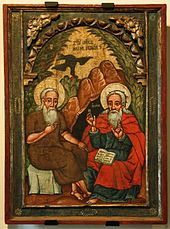
Elijah and Enoch - seventeenth-century icon, Historic Museum in Sanok, Poland


Idris (prophet)

ʾIdrīs (Arabic: إدريس‎) is an ancient prophet and patriarch mentioned in the Quran, whom Muslims believe was the second prophet after Adam.[1] Islamic tradition has unanimously identified Idris with the biblical Enoch,[2][3] although many Muslim scholars of the classical and medieval periods also held that Idris and Hermes Trismegistus were the same person.[4][5]
(Not to be confused with Iblis, aka Shaitan.)
He is described in the Qur'an as "trustworthy" and "patient"[6] and the Qur'an also says that he was "exalted to a high station".[7][8] Because of this and other parallels, traditionally Idris has been identified with the Biblical Enoch,[9] and Islamic tradition usually places Idris in the early Generations of Adam, and considers him one of the oldest prophets mentioned in the Qur'an, placing him between Adam and Noah.[10] Idris' unique status[11] inspired many future traditions and stories surrounding him in Islamic lore.
According to hadith, narrated by Malik ibn Anas and found in Sahih Muslim, it is said that on Muhammad's Night Journey, he encountered Idris in the fourth heaven.[12] The traditions that have developed around the figure of Idris have given him the scope of a prophet as well as a philosopher and mystic,[13] and many later Muslim mystics, or Sufis, including Ruzbihan Baqli and Ibn Arabi, also mentioned having encountered Idris in their spiritual visions.[14]
Name
The name "Idris", إدريس, has been described as perhaps having the origin of meaning "interpreter."[15] Traditionally, Islam holds the prophet as having functioned an interpretive and mystical role and therefore this meaning garnered a general acceptance. Later Muslim sources, those of the eighth century, began to hold that Idris had two names, "Idris" and "Enoch," and other sources even stated that "Idris' true name is Enoch and that he is called Idris in Arabic because of his devotion to the study of the sacred books of his ancestors Adam and Seth."[16] Therefore, these later sources also highlighted Idris as either meaning "interpreter" or having some meaning close to that of an interpretive role. Several of the classical commentators on the Qur'an, such as Al-Baizawi, said he was "called Idris from the Arabic dars, meaning "to instruct," from his knowledge of divine mysteries."[17]
Qur'an
Idris is mentioned twice in the Qur'an, where he is described as a wise man. In chapter 19 of the Qur'an, God says:

Also mention in the Book the case of Idris: He was a man of truth (and sincerity), (and) a prophet:
And We raised him to a lofty station.
— Qur'an, Chapter 19 (Mary), verses 56-57[7]

Later, in chapter 21, Idris is again praised:

And (remember) Isma'il, Idris, and Dhul-Kifl,[18] all (men) of constancy and patience;
We admitted them to Our mercy: for they were of the righteous ones.
— Qur'an, Chapter 21 (Prophets), verses 85-86[19]
Life and prophethood
Idris was born in Babylon, a city in present-day Iraq. Before he received the Revelation, he followed the rules revealed to Prophet Seth, the son of Adam. When Idris grew older, God bestowed Prophethood on him. During his lifetime all the people were not yet Muslims. Afterwards, Idris left his hometown of Babylon because a great number of the people committed many sins even after he told them not to do so. Some of his people left with Idris. It was hard for them to leave their home.

They asked Prophet Idris: "If we leave Babylon, where will we find a place like it?" Prophet Idris said: "If we immigrate for the sake of Allah, He will provide for us." So the people went with Prophet Idris and they reached the land of Egypt. They saw the Nile River. Idris stood at its bank and mentioned Allah, the Exalted, by saying: "Subhanallah."[20]
Muslim literature
Islamic literature arrates that Idris was made prophet at around 40, which parallels the age when Muhammad began to prophesy, and lived during a time when people had begun to worship fire.[21] Exegesis embellishes upon the lifetime of Idris, and states that the prophet divided his time into two. For three days of the week, Idris would preach to his people and four days he would devote solely to the worship of God.[21] Many early commentators, such as Tabari,[22] credited Idris with possessing great wisdom and knowledge.

Exegesis narrates that Idris was among "the first men to use the pen as well as being one of the first men to observe the movement of the stars and set out scientific weights and measures."[21] These attributes remain consistent with the identification of Enoch with Idris, as these attributes make it clear that Idris would have most probably lived during the Generations of Adam,[21] the same era during which Enoch lived. Ibn Arabi described Idris as the "prophet of the philosophers" and a number of works were attributed to him.[23] Some scholars wrote commentaries on these supposed works,[24] all while Idris was also credited with several inventions, including the art of making garments.[23]

The commentator Ibn Ishaq narrated that he was the first man to write with a pen and that he was born when Adam still had 308 years of his life to live. In his commentary on the Quranic verses 19:56-57, the commentator Ibn Kathir narrated "During the Night Journey, the Prophet passed by him in fourth heaven. In a hadith, Ibn Abbas asked Ka’b what was meant by the part of the verse which says, ”And We raised him to a high station.” Ka’b explained: Allah revealed to Idris: ‘I would raise for you every day the same amount of the deeds of all Adam’s children’ – perhaps meaning of his time only. So Idris wanted to increase his deeds and devotion. A friend of his from the angels visited and Idris said to him: ‘Allah has revealed to me such and such, so could you please speak to the angel of death, so I could increase my deeds.’ The angel carried him on his wings and went up into the heavens. When they reached the fourth heaven, they met the angel of death who was descending down towards earth. The angel spoke to him about what Idris had spoken to him before. The angel of death said: ‘But where is Idris?’ He replied, ‘He is upon my back.’ The angel of death said: ‘How astonishing! I was sent and told to seize his soul in the fourth heaven. I kept thinking how I could seize it in the fourth heaven when he was on the earth?’ Then he took his soul out of his body, and that is what is meant by the verse: ‘And We raised him to a high station.’[25]

Early accounts of Idris' life attributed "thirty portions of revealed scripture" to him.[17] Therefore, Idris was understood by many early commentators to be both a prophet as well as a messenger. Several modern commentators have linked this sentiment with Biblical apocrypha such as the Book of Enoch and the Second Book of Enoch.[17]
Identification
Enoch


Elijah and Enoch - seventeenth-century icon, Historic Museum in Sanok, Poland

Idris is generally accepted to be the same as Enoch. Many of the early Qur'anic commentators, such as Tabari and Al-Baizawi identified Idris with Enoch. Al-Baizawi said: "Idris was of the posterity of Seth and a forefather of Noah, and his name was Enoch (ar. Uhnukh)"[17] Classical commentators used to popularly identify Idris with Enoch, the patriarch who lived in the Generations of Adam. An example is İsmail Hakkı Bursevî's commentary on Fusus al-hikam by Muhyiddin ibn ʻArabi.[26] Modern scholars, however, do not concur with this identification because they argue that it lacks definitive proof. As Qur'anic translator Abdullah Yusuf Ali says in note 2508 of his translation:

Idris is mentioned twice in the Quran, viz., here and in Chapter 21, verse 85, where he is mentioned as among those who patiently persevered. His identification with the Biblical Enoch, may or may not be correct. Nor are we justified in interpreting verse 57 here as meaning the same thing as in Genesis, v.24 ("God took him"), that he was taken up without passing through the portals of death. All we are told is he was a man of truth and sincerity, and a prophet, and that he had a high position among his people.
— Abdullah Yusuf Ali, The Holy Qur'an: Text, Translation and Commentary[27]

With this identification, Idris's father becomes Yarid (Arabic يريد), his mother Barkanah, and his wife Aadanah. Idris's son Methuselah would eventually be the grandfather of Prophet Nuh (Noah). Hence Idris is identified as the great-grandfather of Noah.[28]
Hermes Trismegistus
A late Arabic writer wrote of the Sabaeans that their religion had a sect of star worshipers who held their doctrine to come from Hermes Trismegistus through the prophet Adimun.[29]
Antoine Faivre, in The Eternal Hermes (1995), has pointed out that Hermes Trismegistus has a place in the Islamic tradition, although the name Hermes does not appear in the Qur'an. Hagiographers and chroniclers of the first centuries of the Islamic Hegira quickly identified Hermes Trismegistus with Idris,[30] the nabi of surahs 19.57 and 21.85, whom the Arabs also identified with Enoch (cf. Genesis 5.18–24). Idris/Hermes was termed "Thrice-Wise" Hermes Trismegistus because he had a threefold origin. The first Hermes, comparable to Thoth, was a "civilizing hero", an initiator into the mysteries of the divine science and wisdom that animate the world; he carved the principles of this sacred science in hieroglyphs. The second Hermes, in Babylon, was the initiator of Pythagoras. The third Hermes was the first teacher of alchemy. "A faceless prophet," writes the Islamicist Pierre Lory, "Hermes possesses no concrete or salient characteristics, differing in this regard from most of the major figures of the Bible and the Quran."[31] A common interpretation of the representation of "Trismegistus" as "thrice great" recalls the three characterizations of Idris: as a messenger of god, or a prophet; as a source of wisdom, or hikmet (wisdom from hokmah); and as a king of the world order, or a "sultanate". These are referred to as müselles bin ni'me.#fastitlinks.com